

Can Sunscreen Help With Pigmentation? The Dark Spot Step Most Routines Miss
You can use vitamin C, niacinamide, exfoliating acids, retinoids, or brightening serums — but if daily light exposure keeps signalling your skin to make more pigment, dark spots may look unchanged, return, or become more noticeable.
Before adding another dark spot serum, ask this: are you treating existing pigmentation while leaving the trigger unprotected every morning?
Yes, sunscreen can help with pigmentation — mainly by preventing UV exposure from creating new dark spots and making existing marks darker. It does not usually erase pigmentation on its own. For melasma or visible-light-sensitive pigmentation, a tinted sunscreen containing iron oxides may provide more relevant protection than an untinted UV-only sunscreen.
Most pigmentation routines focus on the treatment step.
A serum is chosen for fading post-acne marks. An exfoliant is added for uneven tone. A retinoid is introduced at night. The routine looks active, expensive, and technically complete — yet the marks remain stubborn.
The missing step is often not another brightening ingredient. It is photoprotection: protecting the skin from the light exposures that can keep pigmentation pathways active.
This does not mean every dark spot is caused only by sunlight. Pigmentation can be linked to acne, irritation, hormonal changes, melasma, medication, injury, or other skin conditions. But once pigment exists, repeated ultraviolet exposure can make it harder to fade. A practical starting point is understanding how SPF, UVA protection, texture, and application work together.
Treat at night. Re-trigger by day.
Brightening products may target existing uneven tone, while unprotected light exposure can keep stimulating the pathways that make dark spots look more persistent.
Marks may improve slightly, then darken again after repeated exposure.
Fewer daily triggers give the routine a more stable environment to work in.
The most expensive dark spot serum cannot outwork repeated unprotected light exposure.
Related GlowBareSkin Guides to Read Next
Dark spot care works best when brightening, barrier support, and daily protection are planned as one routine rather than isolated products.
Does Sunscreen Help With Pigmentation?
Sunscreen helps pigmentation by reducing the ultraviolet exposure that can trigger melanin production, darken existing marks, and make new discoloration more likely. Its strongest role is prevention and protection. Existing spots usually need time, consistent photoprotection, and sometimes targeted skincare or dermatologist treatment.
Think of sunscreen as the stabilising step in a pigmentation routine.
Brightening ingredients may help influence pigment production, skin turnover, inflammation, or the appearance of uneven tone. Sunscreen reduces an external trigger that can work against those efforts. This is why dermatology guidance often places sunscreen at the beginning of a dark spot plan rather than treating it as an optional final detail.
Daily sunscreen may help by:
Preventing New Darkening
Reduces UV exposure that can stimulate additional pigment and make spots look deeper.
Protecting Treatment Progress
Creates more stable conditions for vitamin C, niacinamide, retinoids, or prescribed care.
Reducing Recurrence Risk
Helps limit the repeated light exposure that can reactivate pigmentation-prone areas.
What sunscreen cannot do is identify the cause of a patch, cure hormonal melasma, stop acne, or remove a suspicious changing spot. Pigmentation that is new, rapidly changing, asymmetrical, bleeding, painful, or resistant to routine care should be assessed by a dermatologist.
Prevention is not the same as fading — but fading is harder without prevention.
Sunscreen may not behave like a peel or prescription treatment, yet it can determine whether the rest of the routine makes visible progress.
Why Do Dark Spots Keep Getting Darker?
Dark spots form when melanocytes produce more melanin or when pigment is distributed unevenly after inflammation or injury. Sunlight can intensify this process. UVA reaches deeper into the skin and contributes to tanning, pigment persistence, and photoaging. UVB is more strongly linked to sunburn but can also stimulate pigmentation.
For some people — especially those with medium to deep skin tones and pigment disorders such as melasma or post-inflammatory hyperpigmentation — visible light from the sun can also contribute to persistent darkening. This is the reason tinted sunscreens with iron oxides receive special attention in pigmentation-focused dermatology guidance.
Inflammation starts the mark. Light can keep feeding it.
Acne, irritation, friction, or hormones may begin the pigmentation process. Daily exposure can make the colour look darker and more difficult to clear.
Inflammation activates pigment-producing pathways.
A brown, grey, or purple-toned spot remains after healing.
UV and sometimes visible light deepen the contrast.
The mark takes longer to blend back into surrounding skin.
How Sunscreen Helps Different Types of Pigmentation
“Pigmentation” is a broad word. Sunscreen is relevant across several concerns, but its role is not identical in every case.
What Sunscreen Can — and Cannot — Do
| Concern | How Sunscreen Helps | What Else May Be Needed |
|---|---|---|
| Post-acne marks |
Prevents re-darkening Helps stop healing marks from becoming more contrasted after sun exposure. |
Acne control, gentle care, niacinamide, azelaic acid, retinoids, or dermatologist guidance. |
| Melasma |
Core daily step Broad UV protection is essential; tinted iron-oxide sunscreen may add visible-light protection. |
Dermatologist diagnosis and often a long-term, combination treatment plan. |
| Sun or age spots |
Prevents additional damage Helps reduce new spots and protects treated areas from recurring darkening. |
Topicals, procedures, or dermatologist evaluation to confirm the diagnosis. |
| Post-inflammatory hyperpigmentation |
Protects healing skin Reduces an important external stimulus while inflammation settles. |
Stop the cause of inflammation and avoid irritating over-treatment. |
| Freckles |
Reduces seasonal deepening May help freckles become less pronounced with lower exposure. |
Freckles are genetic and can return with sunlight even after treatment. |
| Unknown changing spot |
Not a diagnosis Sunscreen protects skin but should not be used to self-treat a suspicious lesion. |
Prompt dermatologist assessment. |
Sunscreen is a shared foundation, not a universal cure. The correct treatment depends on what caused the pigmentation and how deep the pigment sits in the skin.
UVA, UVB, and Visible Light: What Matters for Dark Spots?
SPF mainly describes protection against UVB. Pigmentation-prone routines also need broad-spectrum UVA protection. For melasma or visible-light-sensitive pigmentation, look for a tinted sunscreen containing iron oxides because ordinary untinted sunscreens are not automatically designed to protect against visible light.
Burning & Surface Damage
SPF is primarily a measure of UVB protection. UVB can contribute to sunburn and pigment changes.
Tanning & Persistent Tone
UVA contributes to tanning, photoaging, and uneven pigmentation. Broad-spectrum or PA-labelled protection matters.
Visible-Light Darkening
Visible light can worsen certain pigment disorders; iron oxides are commonly used to improve visible-light protection.
A high SPF number does not automatically mean equally strong UVA or visible-light protection. Read more about label interpretation in our complete SPF and PA sunscreen guide.
What Is the Best Sunscreen for Pigmentation?
The best sunscreen for pigmentation is one that offers broad-spectrum protection, at least SPF 30, strong UVA coverage, a texture you can apply generously, and enough cosmetic comfort for daily use. For melasma or stubborn visible-light-sensitive pigmentation, choose a tint that contains iron oxides and matches your skin tone.
Choose protection you will actually use correctly.
The best laboratory rating becomes less useful when the formula pills, stings, leaves a cast, or feels so heavy that you apply too little.
Look for UVA and UVB coverage.
Use an appropriate daily baseline.
Choose a texture you can apply generously.
Add tint for visible-light-focused protection.
- Broad-spectrum protection: helps cover both UVA and UVB exposure.
- At least SPF 30: a practical minimum recommended by dermatology organisations for exposed skin.
- Strong UVA protection: look for a PA rating or recognised broad-spectrum labelling.
- Tint with iron oxides: especially relevant for melasma and visible-light-triggered pigmentation.
- Water resistance: useful during sweating, sports, humid outdoor days, or swimming.
- Non-comedogenic texture: may improve adherence if acne is the original cause of your marks.
- No obvious cast or pilling: cosmetic elegance makes correct daily application easier.
Do You Need Tinted Sunscreen for Pigmentation?
Not everyone needs a tinted sunscreen for every situation. Untinted broad-spectrum sunscreen still provides important UV protection and is far better than skipping sunscreen. But for melasma, recurrent post-inflammatory hyperpigmentation, or dark spots that deepen despite consistent UV sunscreen, visible light may deserve more attention.
Tinted sunscreens commonly use iron oxides to reduce the amount of visible light reaching the skin. Studies and dermatology guidance suggest that these formulas can outperform untinted UV-only sunscreens for visible-light-induced pigmentation.
Which One Fits Your Pigmentation Goal?
| Sunscreen Type | Best Fit | Important Limitation |
|---|---|---|
| Untinted broad-spectrum sunscreen |
Daily UV protection Useful for routine UVA and UVB protection when applied correctly. |
Do not assume it protects against visible light unless the formulation is specifically designed and tested for it. |
| Tinted sunscreen with iron oxides |
Pigmentation-focused protection Especially relevant for melasma and visible-light-sensitive discoloration. |
The shade must blend with your skin tone or you may under-apply it. |
| Makeup with SPF |
Additional layer May add pigment and cosmetic coverage over a dedicated sunscreen. |
Most people do not apply enough makeup to rely on it as their primary sunscreen. |
| Powder or spray SPF |
Top-up convenience Can be useful for touch-ups over makeup. |
Coverage can be uneven; do not depend on it as the only morning layer. |
Iron oxide should appear in the ingredient list. A beige colour alone does not prove meaningful visible-light protection.
How to Apply Sunscreen for Pigmentation Protection
Apply sunscreen as the final skincare step every morning, use enough to cover the face, ears, neck, hairline, and exposed chest, and reapply about every two hours during continued outdoor exposure — sooner after swimming, heavy sweating, or wiping the face.
Most real-world sunscreen failure comes from under-application, missed areas, delayed application, or no reapplication. For pigmentation, small unprotected areas can remain visibly darker than the rest of the face.
Treat first. Protect last.
Let each layer settle briefly so sunscreen can form an even film instead of being diluted or rubbed away.
Use a gentle cleanser or rinse as needed.
Apply a compatible antioxidant or tone serum.
Add hydration if your skin needs it.
Apply evenly as the final skincare layer.
Use Enough
A practical face-and-neck guide is two full finger lengths, but product texture and face size vary. The goal is an even, generous film.
Cover Forgotten Areas
Include ears, upper lip, hairline, jawline, sides of the face, neck, and chest when exposed.
Allow It to Set
Give sunscreen time to form an even layer before makeup, masks, or rubbing the face.
Reapply by Exposure
Top up during prolonged outdoor exposure and after sweating, swimming, or towel-drying.
A Simple AM Routine for Pigmentation and Dark Spots
A strong pigmentation routine does not need seven serums. It needs compatible steps used consistently without causing new irritation. Our skinimalism guide explains why fewer, better-planned products can outperform an overloaded routine.
Four Steps That Work Together
| Step | Purpose | Ingredient Direction |
|---|---|---|
| 1. Gentle cleanse | Removes overnight oil without creating irritation that can worsen PIH. | Low-foam or non-stripping cleanser suited to your skin type. |
| 2. Tone-support serum | Targets the appearance of uneven tone and adds antioxidant or barrier support. | Vitamin C, niacinamide, azelaic acid, or a dermatologist-prescribed option. |
| 3. Moisturizer | Supports barrier comfort so treatment is less likely to sting or cause new inflammation. | Glycerin, hyaluronic acid, ceramides, panthenol, or squalane as needed. |
| 4. Sunscreen | Reduces UV-triggered darkening and protects the progress of the routine. | Broad-spectrum SPF 30+; tinted iron oxide formula when visible-light protection is a priority. |
Irritation can create more pigmentation. Introduce one active at a time and reduce frequency if skin burns, peels, or remains red.
For ingredient selection, compare L-ascorbic acid with gentler vitamin C derivatives, explore the role of niacinamide for uneven-looking tone, and learn how bakuchiol can fit into a nighttime routine.
7 Sunscreen Mistakes That Keep Pigmentation Stubborn
Applying Too Little
A thin, patchy layer cannot provide the labelled protection evenly across the face.
Using SPF Only in Summer
UVA exposure occurs throughout the year and can reach skin during routine travel.
Ignoring Window Exposure
UVA can pass through ordinary window glass, especially relevant during driving or desk-side exposure.
Skipping Reapplication Outdoors
Sweat, rubbing, water, and time reduce the uniformity of the sunscreen film.
Relying on Makeup SPF
Most people do not apply foundation or powder in the amount required for full labelled SPF.
Over-Exfoliating
Irritation can create new inflammation and post-inflammatory hyperpigmentation.
Assuming High SPF Covers Visible Light
Visible-light protection usually requires pigment-based formulation such as iron oxides.
When sunscreen suddenly stings, the problem may be a stressed barrier rather than the sunscreen alone. Review the signs that retinol, acids, or vitamin C are overwhelming your skin.
How Long Does Pigmentation Take to Fade With Sunscreen?
Sunscreen can reduce ongoing darkening immediately when used correctly, but visible fading takes time. Superficial post-inflammatory marks may improve over several months, while deeper pigment and melasma can persist much longer and often need targeted treatment.
The American Academy of Dermatology notes that a dark spot only a few shades deeper than the natural skin tone may take around six to twelve months to fade after the cause is stopped. Deeper discoloration can take years. This is why expecting a serum to erase marks in seven days usually leads to overuse and irritation.
Pigmentation improvement is usually measured in months, not product launches.
- Weeks 1–4: fewer new marks or less rapid darkening may be the first sign of progress.
- Months 2–3: superficial post-acne marks may begin to look softer with consistent treatment and protection.
- Months 3–6: more visible blending may occur, depending on pigment depth and the original trigger.
- Longer-term: melasma, deep dermal pigment, or repeated inflammation may require dermatologist-led treatment.
These are broad expectations, not guaranteed treatment timelines. Skin type, pigment depth, hormones, acne activity, adherence, medication, and formula tolerance all influence results.
Watch Before Adding Another Dark Spot Product
These dermatologist-led videos explain visible-light protection, tinted sunscreen, and correct application for pigmentation-prone routines.
Why Tinted Sunscreen Matters for Pigmentation
A dermatologist explains how iron oxides help protect against visible light and why this can matter for melasma and stubborn dark spots.
How to Apply Sunscreen Correctly
Application quantity, timing, missed areas, and reapplication can determine whether the protection on the label reaches your skin.
Where GlowBareSkin SunShield Fits in a Pigmentation Routine
Daily UV Protection That Feels Easy Enough to Use Consistently
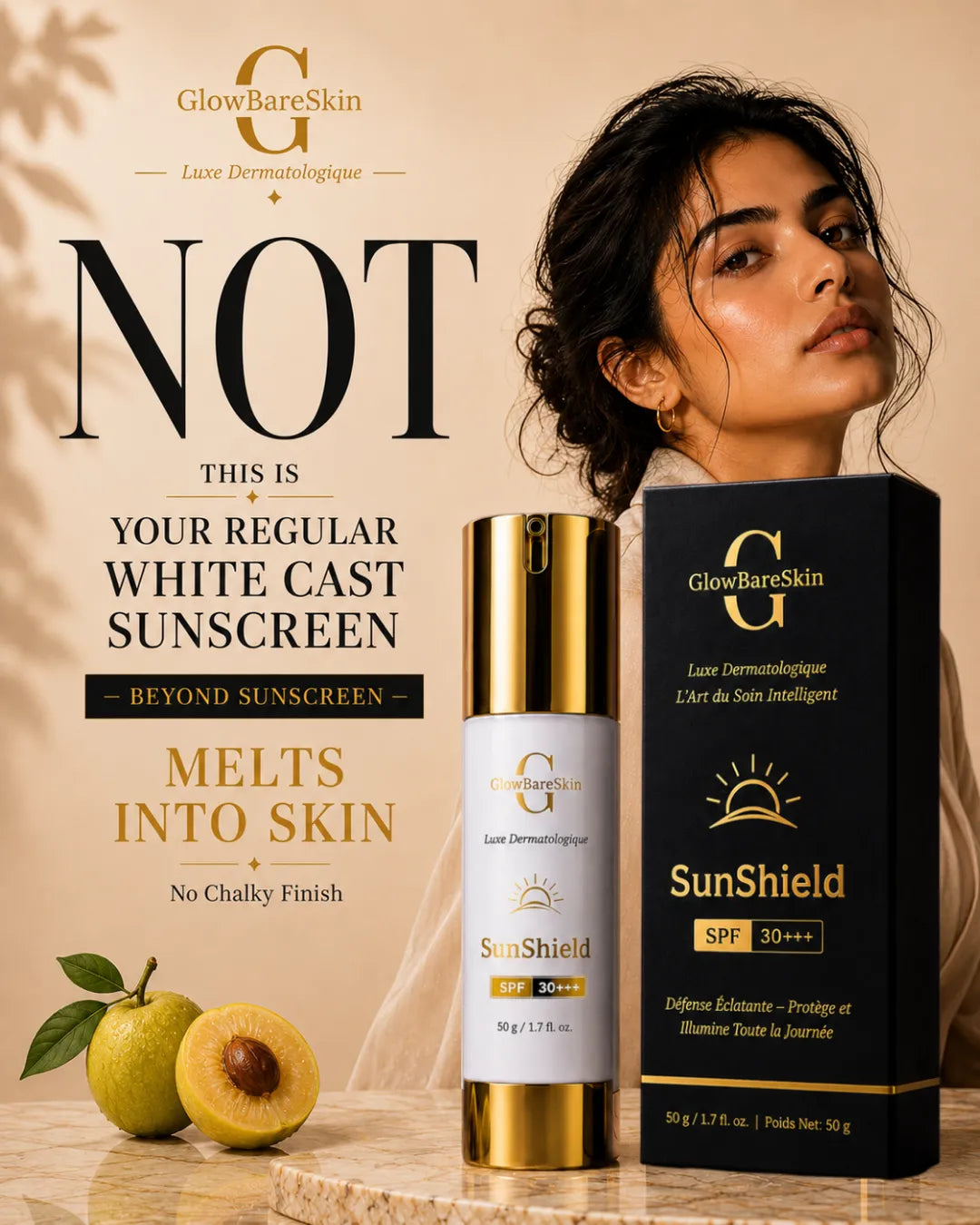
GlowBareSkin SunShield SPF 30+++ is a lightweight broad-spectrum daily sunscreen formulated with Kakadu Plum, 3% Niacinamide, Hyaluronic Acid, and Aloe Vera. It is designed to layer as the final morning step with a fresh, hydrated, non-greasy finish and no obvious white cast.
For a routine focused on uneven-looking tone, SunShield helps protect against UVA and UVB exposure while niacinamide and antioxidant-rich Kakadu Plum support a brighter-looking daily finish. Consistent use matters more than keeping a sunscreen in the cabinet for “sunny days.”

Protect the progress of your morning routine.
A comfortable daily SPF with Kakadu Plum, 3% Niacinamide, Hyaluronic Acid, and Aloe Vera for UV protection, hydration, and a refined no-white-cast finish.
GlowBareSkin SunShield is an untinted broad-spectrum UV sunscreen and is not presented as an iron-oxide visible-light sunscreen. If melasma or visible-light-triggered pigmentation is your primary concern, discuss a tinted iron-oxide sunscreen with your dermatologist rather than assuming any untinted SPF covers visible light.
For a paired morning approach, apply GlowBareSkin LumiSkin Day Elixir with 5% Niacinamide and 3% Kakadu Plum before moisturizer and sunscreen.
Final Verdict: Can Sunscreen Fade Pigmentation?
Sunscreen can help pigmentation, but its main job is not to bleach an existing spot. It prevents repeated UV exposure from making marks darker, reduces the chance of new sun-induced discoloration, and protects the progress of targeted treatments. For melasma and visible-light-sensitive pigmentation, tinted iron-oxide sunscreen may provide an important advantage.
If your dark spot routine is not working, do not immediately add another acid. First audit the protection step: broad-spectrum coverage, UVA protection, application amount, missed areas, reapplication, and whether visible-light protection is relevant to your condition.
The dark spot step most routines miss is not always a stronger treatment. It is the daily discipline that stops treatment from being undone.
Science-Backed Skinimalism for Smarter Daily Skincare
GlowBareSkin is a luxury, science-backed skincare brand built around skinimalism, ingredient education, and simplified routines. Our philosophy is simple: fewer products, stronger formulation logic, and daily steps people can follow consistently.
GlowBareSkin products are designed to support concerns such as uneven-looking tone, dullness, dehydration, barrier comfort, and daily sun exposure without turning skincare into an overwhelming routine.
Frequently Asked Questions
Can sunscreen remove dark spots?
Sunscreen usually does not remove dark spots by itself. It helps prevent existing marks from becoming darker and protects the results of ingredients or treatments that target pigmentation.
Which SPF is best for pigmentation?
Choose broad-spectrum sunscreen with at least SPF 30 and strong UVA protection. For long outdoor exposure or intense sunlight, SPF 50 may offer a useful margin when applied correctly and reapplied.
Is SPF 30 enough for dark spots?
SPF 30 can be appropriate for daily use when it is broad-spectrum, applied generously, and reapplied during continued exposure. Pigmentation-prone skin should also prioritise UVA protection rather than looking at SPF alone.
Is tinted sunscreen better for pigmentation?
Tinted sunscreen containing iron oxides can be better for melasma and visible-light-sensitive pigmentation because it may protect against visible light in addition to ultraviolet radiation.
Does sunscreen help post-acne marks?
Yes. Sunscreen helps prevent post-acne marks from darkening after UV exposure. It works best when acne is controlled and the routine avoids irritation that can create new marks.
Can I use vitamin C instead of sunscreen?
No. Vitamin C may provide antioxidant and brightening support, but it does not replace a tested sunscreen. Use compatible vitamin C under sunscreen rather than choosing one or the other.
Should I wear sunscreen indoors for pigmentation?
Indoor use is most relevant when you spend time near bright windows, drive regularly, or receive meaningful daylight exposure through glass. UVA can pass through ordinary window glass.
How often should I reapply sunscreen for pigmentation?
Reapply about every two hours during ongoing outdoor exposure and after swimming, sweating, or wiping the face. A mostly indoor day with little daylight exposure may require a different practical schedule.
Can sunscreen make pigmentation worse?
Sunscreen should not biologically worsen pigmentation, but irritation from a formula can trigger inflammation in reactive skin. Stop using a product that causes persistent burning, rash, or swelling and seek professional advice.
Why are my dark spots not fading even though I use sunscreen?
You may be applying too little, missing UVA or visible-light protection, not treating the original cause, or dealing with deeper pigment that needs prescription care. Hormones, active acne, friction, and irritation can also keep creating new pigment.
References
- American Academy of Dermatology: How to fade dark spots in darker skin tones
- American Academy of Dermatology: How to choose the right sunscreen
- Castanedo-Cazares et al.: Near-visible light and UV photoprotection in melasma
- Dumbuya et al.: Iron-oxide formulations and visible-light-induced pigmentation
- Zhou et al.: Guide to tinted sunscreens in skin of colour
- Melasma: Tailored photoprotection and visible-light protection
- The role of sunscreen in melasma and post-inflammatory hyperpigmentation
Bathula Meghana, Founder of GlowBareSkin
Bathula Meghana writes about skincare formulation logic, ingredient education, skinimalism, and the practical gap between buying products and building a routine people can follow consistently.
About This Guide
This GlowBareSkin guide is written for educational skincare awareness. It explains the relationship between sunscreen, ultraviolet radiation, visible light, melasma, post-inflammatory hyperpigmentation, dark spots, and routine adherence using dermatology guidance and peer-reviewed literature. It is not medical advice and does not replace a dermatologist consultation for persistent melasma, rapidly changing spots, rashes, medication-related pigmentation, pregnancy-related concerns, or suspected skin disease.


