

The Anti-Aging Ingredient That is Challenging Retinol
Retinol has been the gold standard of anti-aging skincare for years. But if your skin gets dry, flaky, sensitive, or irritated every time you try it, one plant-derived ingredient is changing the conversation: bakuchiol.
For a long time, the anti-aging skincare conversation had one dominant answer: retinol. Fine lines? Retinol. Texture? Retinol. Sun damage? Retinol. Uneven tone? Retinol.
And to be clear, retinol and retinoids are well-established ingredients with strong dermatology relevance. They are often used for mild fine lines, pigmentation irregularities, acne concerns, and visible signs of photoaging. But retinol is not always easy to use. For many people, it can come with dryness, peeling, stinging, sensitivity, and a routine that feels more like a skin challenge than a skin ritual.
That is why bakuchiol has become one of the most talked-about retinol alternatives in modern skincare. It is not the same molecule as retinol. It does not make exaggerated overnight promises. But research suggests it can support visible improvement in photoaging concerns while being better tolerated by many users.
GlowBareSkin Takeaway: Bakuchiol is not “retinol with a prettier name.” It is a plant-derived, retinol-like cosmetic active that offers a gentler path for people who want smoother-looking, brighter-looking, more refined skin without the usual retinol drama.
Table of Contents
- Quick Answer: What Ingredient Is Challenging Retinol?
- Why Retinol Works — and Why It Can Frustrate Skin
- What Is Bakuchiol?
- What Does the Science Say?
- Bakuchiol vs Retinol: What Is the Difference?
- Who Should Consider Bakuchiol?
- How to Use Bakuchiol in a Night Routine
- GlowBareSkin LumiSkin Night Elixir
- Common Mistakes to Avoid
- Helpful Videos
- Frequently Asked Questions
- References
Quick Answer: What Ingredient Is Challenging Retinol?
Bakuchiol is the anti-aging ingredient challenging retinol. It is a plant-derived cosmetic active often described as a gentler retinol alternative for smoother-looking texture, fine-line care, dullness, and uneven-looking tone.
Plant-Derived
Bakuchiol is associated with the babchi plant and is popular in modern botanical skincare.
Retinol-Like Benefits
It is studied for visible photoaging concerns like wrinkles, texture, and uneven-looking tone.
Gentler Feel
Many users choose it when traditional retinol feels too drying, peeling, or irritating.
The future of anti-aging skincare is not only about strength. It is about results people can actually tolerate, repeat, and build into real routines.
Why Retinol Works — and Why It Can Frustrate Skin
Retinol is a form of vitamin A used in skincare to help improve the appearance of fine lines, texture, uneven tone, and mild acne-related concerns. Retinoids are widely discussed in dermatology because they influence skin renewal pathways and can support visible improvement over time.
The problem is not that retinol lacks value. The problem is that retinol can be hard to tolerate. Beginners often experience dryness, flaking, purging-like confusion, stinging, or irritation when they start too quickly or use too much. Sensitive skin types may find the adjustment period especially difficult.
- Retinol may feel drying if introduced too aggressively.
- It can sting or peel when the skin barrier is already stressed.
- It often requires slow introduction with moisturizer support.
- Daily sunscreen is essential when using night actives.
- Some people avoid retinoids during pregnancy or breastfeeding unless approved by a doctor.
If your skin has rejected retinol before, it does not mean you cannot use anti-aging skincare. It may mean your routine needs a gentler route.
Curiosity question: What if your skin does not hate anti-aging skincare — it only hates the way traditional retinol was introduced?
What Is Bakuchiol?
Bakuchiol is a plant-derived ingredient used in skincare as a gentler cosmetic alternative to retinol. It became popular because it is associated with retinol-like visible benefits without being a retinoid molecule.
In simple terms, bakuchiol appeals to people who want a night serum that supports smoother-looking texture, fine-line care, uneven-tone improvement, and a more refined glow — but without the harsh feeling that can come with retinol for some users.
It sits at the intersection of modern skincare: botanical origin, cosmetic science, barrier-conscious routines, and a rising consumer preference for effective but more tolerable active ingredients.
What Does the Science Say About Bakuchiol?
The most-cited clinical comparison is a randomized, double-blind, 12-week study that compared bakuchiol 0.5% cream used twice daily with retinol 0.5% cream used once daily. Both groups showed significant improvement in wrinkle surface area and hyperpigmentation, with no statistical difference between the compounds. Retinol users reported more facial scaling and stinging.
Another earlier study described bakuchiol as a retinol-like functional compound based on gene-expression and clinical evaluation. The ingredient is still not as extensively studied as traditional retinoids, but the existing evidence is why it has earned attention as a promising, more tolerable retinol alternative.
| Evidence Point | What It Suggests | How to Interpret It |
|---|---|---|
| 12-week comparison study | Bakuchiol and retinol both improved wrinkles and hyperpigmentation measures. | Promising, but the study size was modest and not the same as decades of retinoid evidence. |
| Tolerability | Retinol users reported more scaling and stinging. | Bakuchiol may be useful for people who struggle with retinol discomfort. |
| Retinol-like activity | Bakuchiol has been explored for retinol-like effects in skin-related pathways. | It should be described as retinol-like, not identical to retinol. |
| Routine fit | Bakuchiol can fit well into minimal night routines. | Consistency still matters more than one dramatic application. |
Balanced verdict: Retinol remains more established. Bakuchiol is the gentler challenger — especially for people who want visible renewal without the common retinol adjustment struggle.
Bakuchiol vs Retinol: What Is the Difference?
Bakuchiol is often marketed as a retinol alternative, but it should not be confused with retinol. They are different ingredients. The better question is not “Which one is universally better?” The better question is “Which one fits your skin, tolerance, lifestyle, and routine?”
| Point | Bakuchiol | Retinol |
|---|---|---|
| Ingredient type | Plant-derived cosmetic active often positioned as a retinol alternative. | Vitamin A derivative with long-standing use in anti-aging skincare. |
| Skin feel | Often preferred by users seeking a gentler, less irritating night active. | Can be effective but may cause dryness, peeling, or stinging, especially at first. |
| Best for | Texture, early fine lines, dullness, uneven-looking tone, and sensitive routines. | Fine lines, texture, acne-related concerns, pigmentation irregularities, and photoaging. |
| Evidence depth | Promising but smaller body of research compared with retinoids. | Much longer history of research and dermatology use. |
| Routine fit | Good for a calmer PM routine and active beginners. | Often needs slow introduction, moisturizer buffering, and careful pairing. |
| SPF need | Daily sunscreen is still recommended in renewal-focused routines. | Daily sunscreen is essential because retinoid routines can increase sun sensitivity. |
Who Should Consider Bakuchiol?
Bakuchiol may be worth considering if you want a smoother-looking, brighter-looking night routine but feel nervous about retinol. It is especially useful for people who want visible renewal without making their routine feel harsh.
- You tried retinol before and stopped because of dryness or stinging.
- Your skin is sensitive, reactive, or barrier-stressed.
- You want to target early fine lines, texture, dullness, or uneven-looking tone.
- You prefer a minimal night routine with one focused serum.
- You want a glow-supporting approach instead of aggressive exfoliation.
- You are building a more skinimalist routine and want fewer steps with stronger purpose.
For a deeper educational guide, read Bakuchiol Face Serum Benefits: A Gentle Alternative for Modern Skincare. If your full routine feels overwhelming, our guide to skinimalism explains how fewer products can still be effective when each step has a clear purpose.
How to Use Bakuchiol in a Night Routine
Bakuchiol is commonly used in the evening as part of a calm, repeatable night routine. The goal is not to layer as many actives as possible. The goal is to help the skin renew, hydrate, and recover without overload.
Cleanse
Remove sunscreen, makeup, sweat, and daily buildup with a gentle cleanser.
Apply
Use a bakuchiol serum on dry skin, following the product’s directions.
Moisturize
Follow with moisturizer to support comfort and barrier care overnight.
- Start slowly if your skin is sensitive.
- Do not mix too many strong actives in the same night routine.
- Patch test first if you are reactive or acne-prone.
- Use sunscreen the next morning to protect visible progress.
- Stay consistent because texture and tone changes take time.
To build the rest of your routine around simple, repeatable basics, read Tips for Good Skin Care: A Simple Daily Routine Backed by Dermatology Basics.
GlowBareSkin LumiSkin Night Elixir: A Bakuchiol-Led Night Serum
GlowBareSkin LumiSkin Night Elixir is a premium bakuchiol-led night serum designed for people who want a refined alternative to a harsh-feeling retinol routine. It is built around 2% Bakuchiol, 5% Rice Fermented Water, 2% Niacinamide, 1% Hyaluronic Acid, 0.5% Retinyl Palmitate, 0.5% Ethyl Ascorbic Acid, D-Panthenol, Vitamin E, and Glycerine.
The goal is not to create a complicated anti-aging routine. The goal is to support smoother-looking texture, brighter-looking skin, hydration, and barrier comfort in one elegant PM serum.
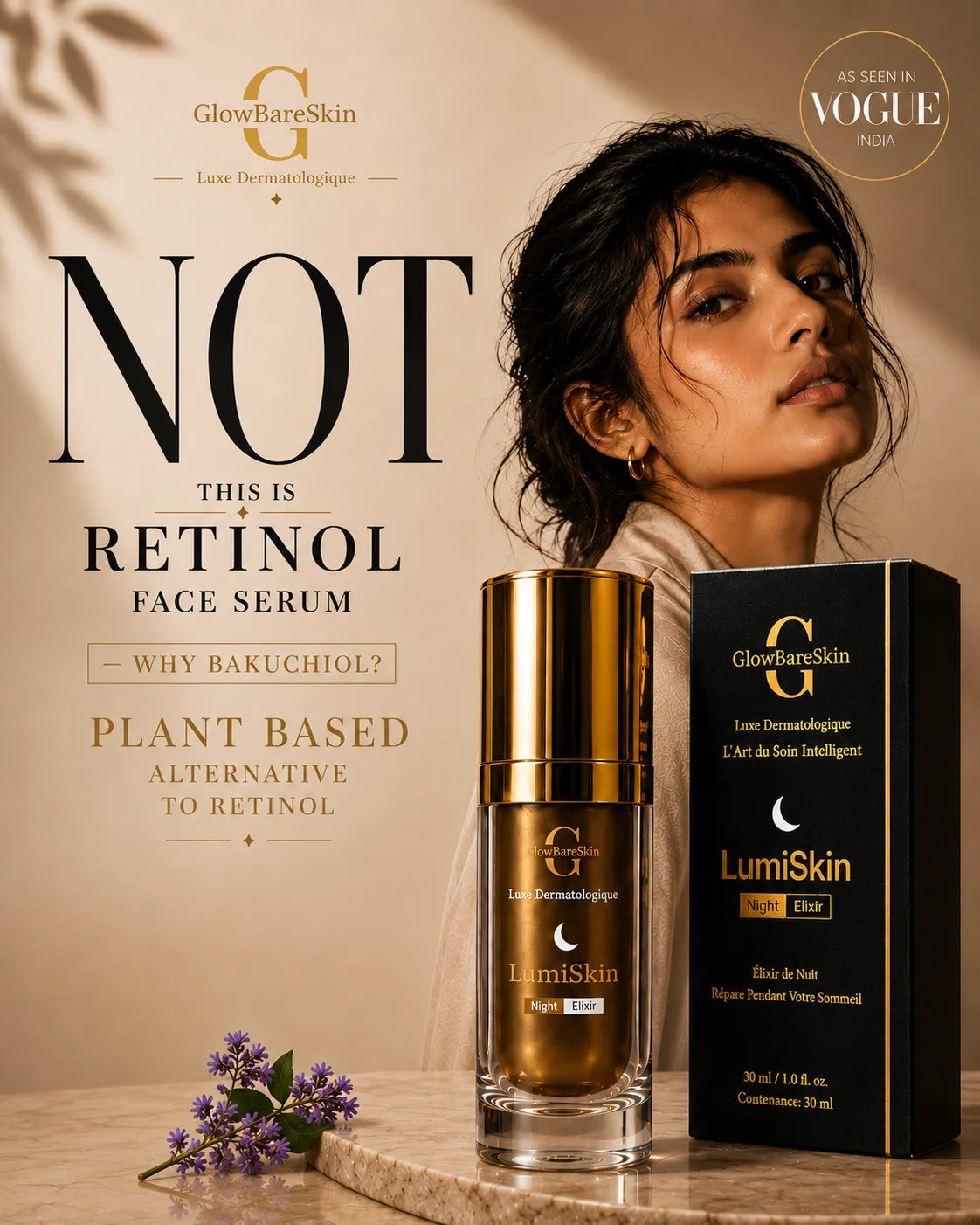
GlowBareSkin LumiSkin Night Elixir
A refined PM serum with 2% Bakuchiol, Rice Fermented Water, Niacinamide, Hyaluronic Acid, Vitamin E, and barrier-supportive hydration.
LumiSkin Night Elixir is bakuchiol-led, but it also contains retinyl palmitate. Use it at night, introduce gradually if needed, avoid during pregnancy or breastfeeding unless your doctor approves, and apply sunscreen the next morning.
Common Bakuchiol Mistakes to Avoid
Bakuchiol is gentler for many people, but that does not mean it should be used carelessly. Any active ingredient can irritate skin when it is layered poorly, introduced too quickly, or used on an already stressed barrier.
| Mistake | Why It Can Be a Problem | Better Habit |
|---|---|---|
| Using it with too many actives | Layering exfoliating acids, retinoids, and strong treatments together can increase irritation. | Keep the night routine simple: cleanse, bakuchiol serum, moisturizer. |
| Expecting overnight anti-aging results | Visible texture, tone, and fine-line improvements require consistency. | Think in weeks, not days. |
| Skipping sunscreen | UV exposure can work against brightening and renewal routines. | Use sunscreen every morning. |
| Ignoring irritation | Gentler does not mean irritation-proof. | Pause if skin burns, peels, swells, or stays irritated. |
| Using during pregnancy without checking | Some bakuchiol formulas may include retinoid derivatives or other actives. | Always check the full formula and consult your doctor. |
Is Bakuchiol Better Than Retinol?
Bakuchiol is not universally better than retinol. Retinol has more decades of evidence and remains a powerful anti-aging ingredient. But bakuchiol may be better for people who value gentleness, comfort, and consistency — especially if they cannot tolerate traditional retinol.
If your skin handles retinol well, you may not need to switch. If retinol repeatedly leaves your skin irritated, bakuchiol gives you another path to explore. That is the real reason it is challenging retinol: not by replacing it for everyone, but by making anti-aging skincare more accessible to people who gave up on retinol.
Final verdict: Retinol is still the classic. Bakuchiol is the challenger for a new generation of barrier-conscious, comfort-first, results-minded skincare routines.
Helpful Videos: Bakuchiol, Retinol Alternatives, and Smarter Night Routines
These videos can help readers understand where bakuchiol fits, how dermatologists discuss retinol alternatives, and why a simple night routine matters.
Video 1: Bakuchiol as a retinol alternative
Why this helps: gives a dermatologist-style discussion of bakuchiol, retinol alternatives, and realistic expectations.
Video 2: Retinol alternatives that actually work
Why this helps: supports the article’s core idea that some people need gentler alternatives, not harsher routines.
Video 3: Choosing the right retinol routine
Why this helps: explains why retinol can still be valuable, but needs thoughtful selection and routine fit.
Frequently Asked Questions
What is the anti-aging ingredient challenging retinol?
Bakuchiol is the anti-aging ingredient challenging retinol. It is a plant-derived cosmetic active often described as a gentler retinol alternative for smoother-looking texture, fine-line care, dullness, and uneven-looking tone.
Is bakuchiol the same as retinol?
No. Bakuchiol is not the same molecule as retinol. It is often described as retinol-like because it has been studied for similar cosmetic benefits, but it works differently and has a smaller evidence base than retinoids.
Is bakuchiol better than retinol for sensitive skin?
Bakuchiol may be better tolerated by many people with sensitive or easily irritated skin. However, sensitive skin can still react to any active, so patch testing and slow introduction are important.
Can bakuchiol help with wrinkles?
Bakuchiol has been studied for photoaging concerns, including wrinkle appearance. In one 12-week comparison study, bakuchiol and retinol both improved wrinkle surface area and hyperpigmentation measures.
Can I use bakuchiol every night?
Many people can use bakuchiol at night, but beginners or sensitive skin types should start 2–3 nights per week and increase gradually if the skin feels comfortable.
Can bakuchiol be used with niacinamide?
Yes, bakuchiol and niacinamide can work well together in a routine because niacinamide helps support barrier comfort and uneven-looking tone. GlowBareSkin LumiSkin Night Elixir combines bakuchiol with niacinamide and hydration-supporting ingredients.
Do I still need sunscreen when using bakuchiol?
Yes. Sunscreen is important in any renewal-focused routine because UV exposure can worsen uneven tone, pigmentation, and visible aging signs. Use sunscreen the next morning after nighttime active use.
Is GlowBareSkin LumiSkin Night Elixir pregnancy-safe?
No. GlowBareSkin LumiSkin Night Elixir contains retinyl palmitate along with bakuchiol, so it should be avoided during pregnancy or breastfeeding unless your doctor approves it.
How long does bakuchiol take to show results?
Hydration and comfort may be noticed earlier, but visible improvements in texture, tone, and fine lines usually require consistent use over several weeks.
Should I choose bakuchiol or retinol?
Choose retinol if your skin tolerates it well and you want a highly established ingredient. Consider bakuchiol if retinol causes dryness, peeling, stinging, or barrier discomfort.
References
- PubMed: Bakuchiol vs Retinol clinical study for facial photoaging
- British Journal of Dermatology: Topical bakuchiol and retinol assessment
- PubMed: Bakuchiol as a retinol-like functional compound
- American Academy of Dermatology: Retinoid or retinol?
- U.S. FDA: Sunscreen and sun protection basics
About GlowBareSkin
GlowBareSkin is a luxury skincare brand built around skinimalism, science-backed ingredient education, and refined daily routines. Our philosophy is simple: fewer products, stronger intention, and skincare people can use consistently.
GlowBareSkin formulas are designed to make high-performance skincare feel more elegant, understandable, and routine-friendly.
Author Note
This guide is written from the perspective of GlowBareSkin founder Bathula Meghana to help readers evaluate anti-aging ingredients with more clarity and less fear-based marketing pressure.
This article is for educational purposes only and does not replace advice from a qualified dermatologist. If you have persistent acne, melasma, severe pigmentation, eczema, rosacea, allergic reactions, photosensitivity, or any medical skin condition, consult a dermatologist before changing your skincare routine.


