


Best Sunscreen to Wear Under Makeup Every Day: No Pilling, Grease or White Cast
Your makeup should not have to choose between a smooth base and daily sun protection. The right sunscreen for face should spread evenly, settle without obvious white residue and sit beneath makeup without turning the morning routine into a battle with flakes, shine or separation.
Does your sunscreen roll into tiny flakes, make foundation slide, leave a grey cast in photos or feel too sticky for everyday wear? This guide explains what causes each problem—and how to build a smoother sunscreen-under-makeup routine.
The best sunscreen to wear under makeup every day is an SPF 30 or higher facial sunscreen with broad-spectrum protection, an even-spreading texture, no obvious white cast and a lightweight finish you can apply generously. Use it after moisturizer as the final skincare step, let it settle, then press makeup over it instead of repeatedly rubbing. GlowBareSkin SunShield SPF 30+++ is a strong daily choice for shoppers seeking a lightweight, non-sticky sunscreen designed to sit under makeup without an obvious chalky finish.
You finish skincare, apply sunscreen and wait. Then the moment foundation touches your face, the base begins to roll into little crumbs. Or everything looks smooth indoors but turns grey in daylight. By noon, the T-zone feels greasy, the makeup has separated and sunscreen is blamed for ruining the entire look.
That frustration is one of the biggest reasons people under-apply sunscreen, skip it on makeup days or replace a proper sunscreen with an SPF-labelled foundation used in a much smaller quantity. The problem is not that sunscreen and makeup cannot work together. The problem is usually the formula, the number of layers, the application method or the amount of friction.
A makeup-compatible sunscreen does not need to behave like a primer or promise a filtered finish. It needs to perform its real job—sun protection—while being cosmetically comfortable enough that you are willing to use the correct amount every day.
Protection only becomes a habit when the finish works with real life.
SPF value matters, but daily compliance also depends on how the sunscreen feels, looks and layers beneath the products you already use.
Daily UV protection.
Less heavy or oily feel.
Less rubbing and fewer excess layers.
If your sunscreen only looks good when you use too little, it is not truly working for your routine.
Looking for a non-sticky SPF that fits your makeup routine?
GlowBareSkin SunShield SPF 30+++ is designed for daily face and neck use, with no obvious white cast and a lightweight finish that can sit beneath makeup.
Related GlowBareSkin Guides
Sunscreen performs best when the layers underneath are simple, compatible and applied in the correct order.
What Makes the Best Sunscreen Under Makeup?
The best sunscreen under makeup combines adequate labelled protection with cosmetic elegance: it should spread evenly at the required amount, settle without obvious residue, remain comfortable through the day and create a surface that does not require aggressive rubbing when foundation is applied.
When someone searches for the “best sunscreen,” they are often asking two different questions. First: does it provide appropriate sun protection? Second: will I actually enjoy wearing it every day?
Research on consumer sunscreen preferences has found that cosmetic elegance—how a sunscreen looks and feels—strongly influences whether people like and continue using a product. That is important because a technically impressive sunscreen provides little real-world benefit when the user applies too little or avoids it on workdays, event days and makeup days.
SPF 30 or Higher
The American Academy of Dermatology recommends broad-spectrum sunscreen with SPF 30 or higher as part of a sun-protection plan.
Broad-Spectrum Coverage
Look for protection against both UVA and UVB exposure rather than judging the product by SPF alone.
No Obvious White Cast
A sunscreen that blends without chalky residue is easier to wear across a wider range of skin tones and makeup finishes.
Non-Sticky Finish
A lightweight, non-greasy feel can make daily application more comfortable, especially in humid weather.
Compatible With Your Base
The sunscreen should settle smoothly enough that foundation can be pressed over it without excessive friction.
Comfort at the Correct Amount
Do not evaluate sunscreen using a tiny cosmetic amount. It must remain wearable when applied generously and evenly.
The texture you prefer may be called a sunscreen lotion, sunscreen cream, fluid, gel or emulsion. The name matters less than the final film it creates on your skin and whether you can apply enough without heaviness, visible residue or repeated pilling.
Why Does Sunscreen Pill Under Makeup?
Sunscreen pills when layers roll, gather or ball into visible flakes instead of remaining as a smooth film. Common triggers include too many skincare layers, excess product, incompatible formula textures, rubbing during application, insufficient settling time and a dry or uneven skin surface.
Pilling is not always proof that a sunscreen is “bad.” A 2024 study examining sunscreen and foundation layering found that pilling was influenced by skin characteristics and application technique. Rubbing in circular and linear motions produced more pilling events than lower-friction techniques.
That explains why the same sunscreen can sit beautifully under makeup for one person and pill immediately for another. The complete layering system matters—not only the SPF bottle.
Too Many Layers Underneath
Toner, essence, two serums, moisturizer, oil, primer and sunscreen can create more film than the skin can hold smoothly.
Too Much Rubbing
Repeated circular massage can lift partially set polymers and create the familiar eraser-like flakes.
Formula Mismatch
Different film formers, silicones, oils, gums and powders may not layer smoothly in every combination.
Layers Have Not Settled
Applying the next product while the previous layer is still moving can disturb the sunscreen film.
Excess Product in One Spot
Large blobs concentrated around the nose, brows or hairline are harder to spread into a uniform film.
Dry or Flaky Surface
Makeup can catch on existing flakes, making sunscreen pilling look more dramatic than it is.
Do This
- Keep the morning routine simple.
- Use thin, even layers beneath sunscreen.
- Spread sunscreen gently across small sections.
- Let the sunscreen settle before makeup.
- Press foundation with a damp sponge or gentle tapping motion.
Avoid This
- Mixing sunscreen into moisturizer or foundation.
- Rubbing each layer for several minutes.
- Using an oil-heavy base beneath a film-forming SPF without testing.
- Brushing foundation aggressively over freshly applied sunscreen.
- Reducing sunscreen to a tiny amount just to prevent pilling.
How to Apply Sunscreen Under Makeup Without Pilling
Use cleanser, optional lightweight serum, moisturizer if needed, sunscreen and then makeup. Sunscreen should remain a separate, generous final skincare layer rather than being mixed with another product.
Create a clean surface without over-stripping.
Use only the treatment your morning routine genuinely needs.
Apply a thin, even layer when your skin needs it.
Apply generously as the final skincare step.
Press, tap and build coverage with minimal friction.
Step 1: Start With a Smooth, Comfortable Base
Use a gentle cleanser and pat the face dry. If there is visible flaking, do not scrub immediately before makeup. Aggressive exfoliation can make the surface more reactive and may create even more texture once sunscreen and foundation are layered.
Step 2: Reduce Optional Morning Layers
A morning serum can fit beautifully beneath sunscreen, but three serums do not automatically produce three times the benefit. Choose one formula that addresses your primary concern and use only enough to create a thin layer.
Step 3: Use Moisturizer According to Skin Need
Dry or dehydrated skin may need moisturizer before sunscreen. Oily skin may prefer a lighter amount, especially when the sunscreen itself contains humectants. Skipping moisturizer is not mandatory; the goal is to avoid unnecessary heaviness while maintaining comfort.
Step 4: Apply Sunscreen Evenly—Not Aggressively
Distribute sunscreen across the forehead, cheeks, nose, chin, neck and commonly missed areas. Spread it gently in sections. The AAD advises using at least about one teaspoon for the face and other exposed head-and-neck areas, often described as an amount covering the lengths of the index and middle fingers. Always follow the product label.
Step 5: Let the Film Settle
There is no universal waiting time that works for every formula and climate. Wait until the sunscreen no longer feels as though it is moving around the face. For many routines, a few minutes is practical. If the base still feels wet, applying primer or foundation immediately can disturb the film.
Step 6: Apply Primer Only If You Need It
Primer goes after sunscreen and before foundation. Use a thin amount only where it solves a specific makeup problem—such as excess shine, visible pores or dryness. Applying primer over the entire face when the sunscreen already creates a smooth base can add another unnecessary layer and increase pilling.
Step 7: Apply Makeup With Less Friction
Dot foundation sparingly, then press or bounce it into place. Avoid dragging a dense brush repeatedly across the same area. Begin with the thinnest coverage you need and build only where required.
Change the movement before changing the product.
Less circular rubbing, fewer layers and more pressing can improve the same sunscreen-and-foundation combination.
Does Primer Go Before or After Sunscreen?
Primer goes after sunscreen. Finish your skincare, apply sunscreen as a separate and even final skincare layer, allow it to settle, then use primer only where needed before applying foundation.
Applying primer underneath sunscreen can interfere with the sunscreen’s ability to form an even film. Applying a large amount of primer on top can also create excessive slip or pilling. The most makeup-compatible approach is usually sunscreen first, a short settling period, then a very thin primer layer—or no primer at all when the sunscreen already creates the finish you want.
Dry Areas
Use a small amount of hydrating primer only where foundation normally catches or looks patchy.
Oily T-Zone
Use mattifying primer selectively on the forehead, nose and chin instead of layering it over the entire face.
Smooth Sunscreen Base
Skip primer when the sunscreen has already settled into an even surface and the foundation applies cleanly.
What Is a No White Cast Sunscreen?
A no white cast sunscreen is designed to spread without leaving an obvious chalky, grey or pale residue on the skin. The result can still vary with the amount applied, skin tone, lighting, photography, application method and products layered underneath.
White cast is more than a cosmetic inconvenience. When visible residue makes users uncomfortable, they may apply less sunscreen than directed. Recent research has therefore treated cosmetic elegance and white-cast measurement as important factors in sunscreen adherence across diverse skin tones.
A true daily-use sunscreen should be evaluated in natural daylight and phone-camera flash—not only under warm bathroom lighting. Apply the labelled quantity, allow it to settle and check the face, hairline, brows and jawline.
Check Daylight
A finish that appears invisible indoors can become more obvious near a window or outdoors.
Check the Hairline
Uneven blending often collects around brows, facial hair and the edges of the face.
Check the Correct Amount
A formula is not truly invisible for your routine if it only disappears when severely under-applied.
Choosing sunscreen specifically for oily skin?
This article stays focused on makeup compatibility. For a complete oily-skin buying guide covering texture, shine, white cast and India-specific product comparisons, read the dedicated GlowBareSkin guide.
Is SPF 30 Enough Under Makeup?
SPF 30 can be appropriate for many everyday makeup routines when the sunscreen provides broad-spectrum protection, is applied generously and is reapplied as directed. Makeup does not increase the protection of an under-applied sunscreen layer.
For extended outdoor exposure, swimming, heavy sweating, sports or photosensitivity concerns, choose protection suited to that use and combine sunscreen with shade, protective clothing, sunglasses and a hat. The purpose of this guide is not to compare every SPF level; it is to help the sunscreen you choose remain smooth and wearable beneath makeup.
Why GlowBareSkin SunShield SPF 30+++ Is a Strong Choice Under Makeup
GlowBareSkin SunShield SPF 30+++ is a strong choice for daily makeup wear because it is formulated and positioned around the exact barriers that make people skip sunscreen: an obvious white cast, sticky feel, greasiness and poor routine compatibility.
SunShield is not positioned as a beach sunscreen, a tinted foundation or a replacement for moisturizer. It is designed as the final morning skincare step for face and neck—after cleanser, serum and moisturizer, and before makeup.
Daily UVA/UVB-focused protection when used correctly.
Designed to blend without a chalky-looking finish.
Made for everyday wear and humid routines.
Designed to sit as the last skincare layer before makeup.
SunShield SPF 30+++ With Kakadu Plum, Niacinamide and Hydration Support
The formula combines UV filters with ingredients chosen to support hydration, comfort and a fresh-looking finish—without positioning sunscreen as another heavy layer.
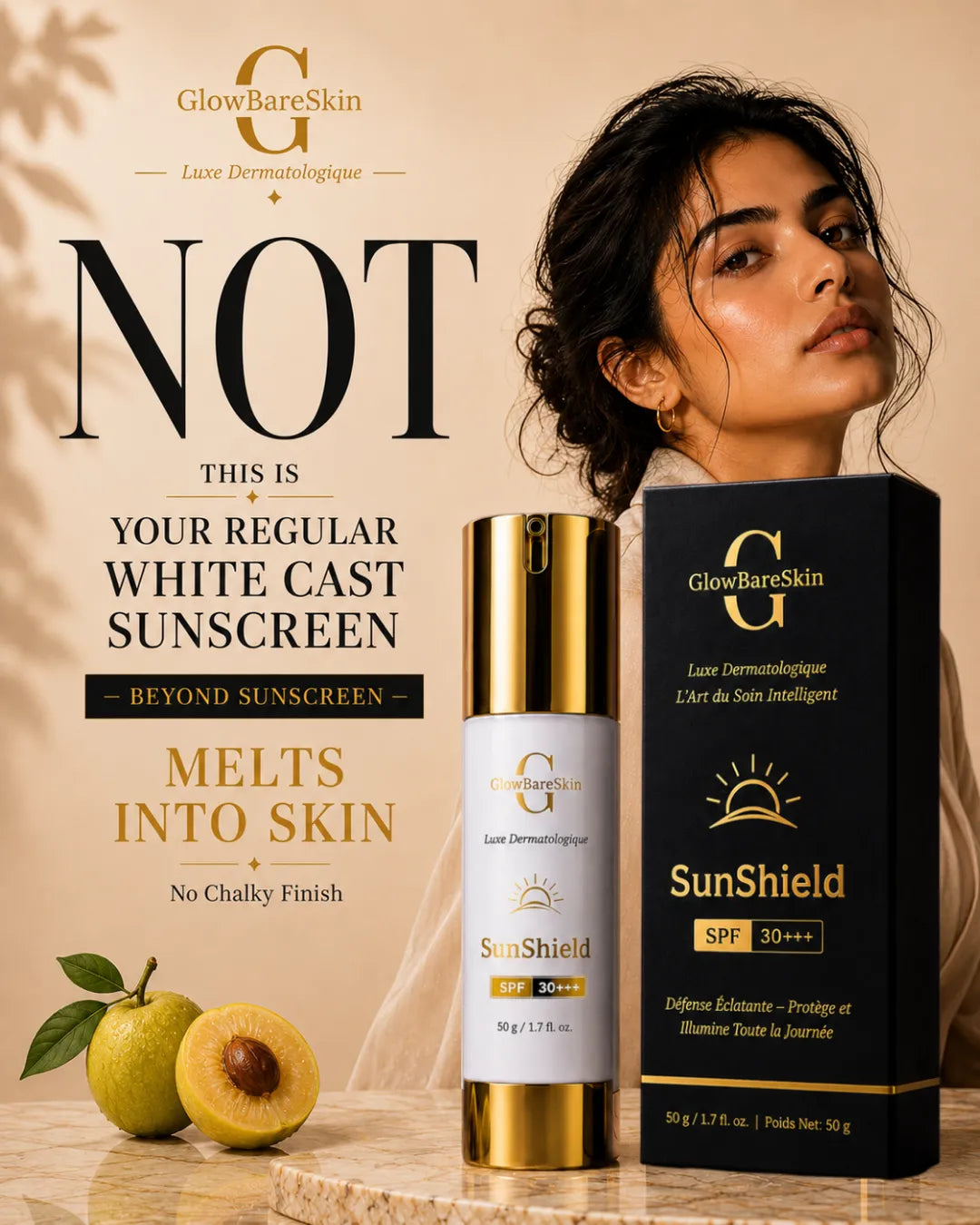
GlowBareSkin SunShield SPF 30+++ Sunscreen
A lightweight daily sunscreen for face and neck, formulated with Octyl Methoxy Cinnamate, Uvinul A Plus and Avobenzone alongside 3% niacinamide, 2% Kakadu plum extract, 2% aloe vera extract, hyaluronic acid, sodium hyaluronate, glycerine and allantoin.
What Each Key Ingredient Contributes
Sun protection plus skincare-compatible support
| Ingredient / Feature | Declared Level | Role in the Formula | Why It Matters Under Makeup |
|---|---|---|---|
| Octyl Methoxy Cinnamate | 7.5% | UVB-filtering component. | Supports labelled sunscreen protection within the complete formula. |
| Uvinul A Plus | 2% | UVA-filtering component. | Contributes to broad daily photoprotection. |
| Avobenzone | 1.5% | UVA-filtering component. | Supports UVA coverage in the sunscreen system. |
| Niacinamide | 3% | Barrier and tone-supporting skincare active. | Adds skincare value without requiring another heavy morning layer. |
| Kakadu Plum Extract | 2% | Antioxidant-rich botanical. | Supports a brighter-looking, glow-friendly finish. |
| Aloe Vera Extract | 2% | Comfort and hydration support. | Helps the formula feel fresh rather than aggressively matte. |
| Hyaluronic Acid + Sodium Hyaluronate | 1% + 1% | Humectant hydration. | Supports a smoother-looking surface beneath makeup. |
| Glycerine | 2% | Humectant. | Helps support hydration without relying on a rich sunscreen cream texture. |
| Allantoin | 0.2% | Skin-comforting ingredient. | Supports everyday wearability. |
Ingredient percentages and product positioning are based on the current GlowBareSkin SunShield SPF 30+++ product information. Individual finish and tolerance can vary.
Why It Is a Strong Choice—Not an Empty “Best Sunscreen” Claim
It Solves a Daily Behaviour Problem
The formula focuses on the comfort barriers that often cause people to skip SPF: stickiness, visible cast and heaviness.
It Fits the Correct Morning Order
Use it after moisturizer and before makeup rather than adding another confusing treatment step.
It Combines Hydration With Protection
Humectants and aloe support a comfortable base without positioning the product as a thick sunscreen cream.
It Is Designed for Visible-Skin Wear
No obvious white cast makes it easier to use across makeup looks and skin tones.
It Supports a Skinimalist Routine
Niacinamide, Kakadu plum and hydration ingredients can reduce the urge to stack multiple heavy morning products.
It Is Honest About Its Use Case
SunShield is strongest as a daily face sunscreen under makeup; intense outdoor or swimming routines need label-specific water-resistance planning.
Patch-test note: The formula contains fragrance. People with highly reactive skin, fragrance sensitivity, active dermatitis or a history of sunscreen allergy should patch test and consult a dermatologist when needed.
“This is the formula I use on my own skin.” GlowBareSkin founder Bathula Meghana developed SunShield around a simple standard: daily sunscreen should feel refined enough that protection does not disappear on makeup days.
How to Wear SunShield Under Different Makeup Looks
For a No-Makeup Makeup Day
Use a lightweight serum, moisturizer only where needed and SunShield as the final skincare layer. Let it settle, then apply concealer strategically rather than covering the entire face with foundation. Finish with cream blush or a small amount of powder on the T-zone.
For Full-Coverage Foundation
Keep the skincare beneath sunscreen minimal. Apply foundation in thin passes with a damp sponge or pressing brush motion. Building two light foundation layers usually creates less disturbance than applying one thick layer and repeatedly blending it.
For Humid Weather and Oily Skin
Use the smallest effective amount of moisturizer, but do not reduce the sunscreen quantity. Allow more settling time, then apply a mattifying primer only where necessary. Set the centre of the face rather than powdering every area heavily.
For Dry or Dehydrated Skin
Apply a comfortable moisturizer beneath sunscreen and avoid a very dry, powder-heavy base. Use a damp sponge, hydrating complexion product and minimal setting powder so makeup does not emphasize surface flakes.
For Event or Photography Makeup
Test the complete routine before the event. Apply the proper amount of sunscreen, photograph the result in daylight and with flash, and assess pilling after the makeup has worn for several hours. Never test a new sunscreen, primer and foundation combination on the event morning.
How Do You Reapply Sunscreen Over Makeup?
For extended outdoor exposure, reapply sunscreen at least every two hours and after sweating, swimming or wiping the face. Over makeup, use gentle pressing rather than rubbing, and accept that maintaining protection may require touching up the complexion afterward.
There is no perfect reapplication technique that preserves every makeup finish while guaranteeing an even sunscreen film. Protection should take priority during direct, prolonged exposure.
Blot—Do Not Wipe
Remove surface oil gently before adding another layer.
Press Sunscreen Over the Base
Use clean fingers or a clean sponge and work in sections with minimal dragging.
Touch Up Makeup Afterward
Restore concealer, blush or powder only where the reapplication changed the finish.
SPF makeup can add another layer, but it should not be treated as a replacement for a properly applied sunscreen because most people use foundation and powder in far smaller amounts than sunscreen testing requires.
Ten Sunscreen-Under-Makeup Mistakes to Stop Making
Using Too Little Sunscreen
A tiny primer-sized amount may look elegant but may not deliver the labelled protection.
Mixing Sunscreen Into Foundation
Mixing can disrupt even application and create an unpredictable sunscreen film.
Layering Every Morning Active
Excess serums and oils increase the chance of pilling without guaranteeing better results.
Applying Makeup Immediately
A moving sunscreen layer is easier to disturb with foundation.
Rubbing Foundation Aggressively
Friction can lift the sunscreen film and create flakes.
Skipping Sunscreen on Cloudy Days
Daily UV exposure does not disappear because the sky looks grey.
Relying Only on SPF Foundation
Makeup is rarely applied in the quantity used for sunscreen testing.
Ignoring the Neck, Ears and Hairline
An even face is not complete protection when exposed areas are missed.
Never Reapplying Outdoors
Sunscreen wears away through time, sweat, touch and wiping.
Choosing Finish Over Use Case
A daily urban sunscreen and a water-resistant sports sunscreen may need different priorities.
Final Verdict: What Is the Best Sunscreen to Wear Under Makeup Every Day?
The best daily sunscreen under makeup is one that provides appropriate broad-spectrum protection, feels comfortable at the correct amount, blends without obvious white cast and remains smooth when makeup is pressed over it. The routine should use fewer underlying layers, minimal rubbing and enough settling time.
GlowBareSkin SunShield SPF 30+++ is a strong choice for this specific need. It directly addresses the reasons makeup wearers abandon sunscreen: visible residue, sticky heaviness, greasy feel and difficult layering. Its UV-filter system is paired with niacinamide, Kakadu plum, aloe vera, hyaluronic acid, sodium hyaluronate, glycerine and allantoin to support a fresh, hydrated finish.
Most importantly, it has one clear role. It is your final morning skincare step—after moisturizer, before makeup and never mixed into either one.
Because the best sunscreen is not the formula that wins a theoretical comparison. It is the formula you apply generously on an ordinary Tuesday, under the makeup you actually wear.
Your sunscreen should protect the makeup routine—not become the reason you skip protection.
Science-Backed Skinimalism for Routines People Can Actually Follow
GlowBareSkin is a founder-led skincare brand built around science-backed skinimalism: fewer products, stronger routine logic and formulas designed to support healthy-looking skin without unnecessary complexity.
SunShield reflects that philosophy by combining daily sun protection with a refined skincare feel, helping sunscreen fit into real workdays, humid weather and makeup routines rather than remaining a product used only on holidays.
Frequently Asked Questions
What is the best sunscreen to wear under makeup every day?
Choose a broad-spectrum sunscreen with SPF 30 or higher, an even-spreading texture, no obvious white cast and a finish comfortable enough to apply generously. GlowBareSkin SunShield SPF 30+++ is designed as a lightweight, non-sticky final skincare step before makeup.
Why does my sunscreen pill under makeup?
Pilling can result from too many skincare layers, incompatible formulas, excessive product in one area, rubbing, insufficient settling time or a dry and flaky skin surface.
How do I stop sunscreen from pilling under foundation?
Simplify the layers underneath, use thin and even skincare amounts, apply sunscreen gently, allow it to settle and press foundation over it with minimal friction instead of rubbing repeatedly.
Should sunscreen go before or after moisturizer?
Apply sunscreen after moisturizer as the final morning skincare step. Makeup is applied after the sunscreen has settled.
How long should I wait after sunscreen before applying makeup?
There is no universal waiting time. Wait until the sunscreen has formed an even layer and no longer feels as though it is moving around the face. A few minutes is practical for many routines.
Can I mix sunscreen with foundation?
No. Mixing sunscreen with foundation or moisturizer can interfere with even application. Apply sunscreen as a separate layer, then apply makeup over it.
Is SPF 30 sunscreen enough for daily use?
SPF 30 can be appropriate for many daily routines when the sunscreen is broad spectrum, applied generously and reapplied as directed. Intense outdoor exposure also requires shade, clothing and a sunscreen suited to sweating or swimming.
Does primer go before or after sunscreen?
Primer goes after sunscreen. Apply sunscreen as the final skincare layer, let it settle, then use a thin amount of primer only where needed before foundation.
Does GlowBareSkin SunShield leave a white cast?
It is designed to blend without an obvious white cast. The visible finish can still vary by skin tone, amount, lighting and application technique.
Can GlowBareSkin SunShield be used under makeup?
Yes. Apply it after serum and moisturizer, allow it to settle and then press makeup over it rather than rubbing aggressively.
Can foundation with SPF replace facial sunscreen?
No. Foundation is usually applied in a much smaller amount than sunscreen testing requires. Use a properly applied facial sunscreen first, then treat SPF makeup as an additional layer rather than a replacement.
How often should I reapply sunscreen when wearing makeup?
During outdoor exposure, reapply at least every two hours and more often after sweating, swimming or wiping the face. Press sunscreen gently over makeup and touch up the complexion afterward.
Research and References
- American Academy of Dermatology: How to choose the right sunscreen.
- American Academy of Dermatology: How to apply sunscreen.
- U.S. Food and Drug Administration: Sunscreen and sun-protection guidance.
- Lua BL, et al. Understanding the causes of skincare product pilling. Skin Research and Technology. 2024.
- Sunscreens: UV filters to protect us—cosmetic acceptability, white cast and pilling.
- Sunscreen product performance and other determinants of consumer preferences.
- Practical recommendations for sunscreen use in India: modified Delphi consensus.
- A standardized method for measuring sunscreen white cast across diverse skin tones.
- Layering sunscreen with facial makeup under real-use conditions.
About This Guide
This article provides general cosmetic and sun-protection education. It does not diagnose or treat acne, melasma, photosensitivity, sunscreen allergy, dermatitis or other medical conditions. Sunscreen is one part of sun protection and should be combined with shade, protective clothing, hats and sunglasses. Follow the product label, patch test new formulas and consult a dermatologist for persistent reactions or medical concerns.


